Free shipping · 90-day guarantee · Molded and packed in Orange, California
The Boat Rental Cup Holder.com ← back to the boat rental page

The boat rental guides

How to Pack for a Rented Pontoon: The List, Built Backward From the Walkthrough

You've never seen the boat, you can't modify it, and it goes back at five. A rented-pontoon packing list built from the rental agreement, not the boat.

15 min read · 11 sources

How to pack for a rented pontoon: the list, built backward from the walkthrough

You have booked a boat you have never stood on. You will meet it at a dock at 9 or 10 in the morning, sign something, listen to four minutes of instruction, and drive away with eight to eleven people and a cooler on a deck whose layout you'll learn by walking it. At five o'clock you bring it back and somebody looks it over while your card is still on file.

That is a strange thing to pack for, and most packing lists don't take it seriously. They give you the same towels-sunscreen-snacks list you'd take to a beach. But a rented boat isn't a beach. It has three constraints a beach doesn't have, and once you accept them, the list mostly writes itself:

  1. You don't know the boat. Not the rail profile, not how many cup holders, not where the shade falls at 2 p.m., not whether there's a single smooth surface anywhere near the seats. Listing photos and a stock spec sheet are the entire preview.
  2. You can't modify it. Nothing drilled, nothing screwed, nothing adhesive, nothing clamped on and left. You signed for the boat in the condition you found it.
  3. Everything you bring has to leave, and nothing you bring can leave a mark.

There's a quiet fourth one: it all has to come down the dock in one trip, and anything that goes over the side is gone. Fresh water doesn't give things back.

Here's the list that survives all four.


1. Pack the paperwork first — it's the only item that can end the day before it starts

Towels you can replace at a gas station. A missing boater education card sends everyone home.

Your boater card, printed or screenshotted. Whether you need one depends on the state and often on your birth year, not on your competence. Boat-Ed's rental guidance notes that most people renting a motorized boat in the US will be asked for a card, that California, New York, New Jersey and Hawaii require certification regardless of age, and that most other states set an age or horsepower threshold — Florida for operators born on or after January 1, 1988 with engines of 10 hp or more, Texas for those born on or after September 1, 1993 with 15 hp or more. Missouri's line is anyone born after January 1, 1984. (Boat-Ed)

Two practical notes. Rental companies can be stricter than the state — a marina in a no-requirement state may still want proof before it hands you a key. And if you took the course online this week, you have a temporary card you can print immediately while the permanent one comes by mail. Print it. Marinas are the last place on the lake with one bar of service and the first place you'll need to load a PDF.

A real credit card in the driver's name. Not a debit card — several operations say so explicitly. Long Beach Marina on Sebago Lake in Maine holds a $1,500 deposit on a major credit card and states "No debit cards." (Long Beach Marina) The hold is not a charge, but it does eat your available credit for the length of the trip, which matters if that's also the card buying dinner.

A driver's license, and a check on the age rule. The same Maine marina requires renters to be at least 25. Not 21, not 18. If the person who booked is 24 and the plan was for them to drive, you want to know that in June, not at the dock.

A screenshot of the agreement and the marina's phone number. You will not have signal at the sandbar.

And arrive early, because the clock isn't yours. At Bass Lake Boat Rentals in California, "Time starts when you reserve the boat (time), regardless of arrival time, and arriving 15 minutes late after due time, you will be charged the full hour, at the hourly rate." (Bass Lake Marina policies) Cappy's on Smith Lake in Alabama asks renters to arrive 30 minutes early and says flatly that rental times cannot be extended for late arrivals. (Cappy's Boats) Half your paid morning can evaporate in the parking lot.


2. Know what's already aboard, so you don't carry it down the dock

The dock walk is longer than it looks and there is rarely a cart. Every item you don't bring is a hand free for the cooler.

A typical pontoon rental already includes the safety gear and the boat-shaped equipment. Salty Pontoons in Panama City Beach lists a map of the area, fuel, Coast Guard–approved life jackets for all passengers and all required safety equipment, plus a Bluetooth radio, a retractable bimini top and an anchor. (Salty Pontoons FAQ) Long Beach Marina lists personal flotation devices, anchor, lines and fenders. (Long Beach Marina)

So: don't pack life jackets for adults. Don't pack a Bluetooth speaker if the boat has a stereo — though a small one is cheap insurance if you can't confirm it, and it's the one gadget nobody regrets.

The exception that catches families. Adult and child jackets are usually stocked; infants are often not. Cappy's makes children's life jackets available on request but states that a life jacket for a child under three is the parent's responsibility to bring. (Cappy's Boats) If there's a baby in the group, that's a call to make when you book, not a thing to discover at 9:15 with seven people waiting.

And read which fuel rule you signed, because there are three of them in circulation and they're not close to each other. Salty Pontoons includes fuel in the rate. Bass Lake sends the boat out full and bills you for what you burn. Grant Motorsports' agreement says the boat "must be returned filled (to the top) with gas" and that if it isn't, "you will be charge for gas plus a $15.00 service fee." (Grant Motorsports rental agreement) On a peer-to-peer booking through a platform, refueling is typically on you and the receipt comes out of the deposit. Knowing which one applies changes whether you budget 40 extra minutes at the end of the day.


3. The weight limit is real, and the cooler counts

This is the part almost nobody checks, and it quietly shapes the whole list.

Find the capacity plate. Federal law requires builders to fit one in sight of the helm on motorized monohull boats under 20 feet, and it doesn't just cap the number of people: it states maximum persons, and separately the maximum carrying weight for persons, motor and gear. (ACE Boater) A pontoon is not a monohull, so that federal rule doesn't reach it and the plate may or may not be there — if it isn't, ask at the counter what the boat is rated for. Either way, gear means your cooler. It means the ice in your cooler — water weighs about 8.3 pounds a gallon, and freezing it doesn't make it lighter. A large hard cooler packed for eleven people for eight hours is not a bag. It's closer to a passenger.

You do not need to do arithmetic on the dock. You need one habit: if you're near the passenger limit, go with one big cooler, not three, load it with drinks and block ice rather than a second cooler of food, and put the heavy thing low and central rather than out on the bow. A pontoon that's loaded to its number handles wakes worse than the same boat half empty, which is exactly the condition under which everything on the deck goes sliding.

The lighter your list, the better the boat behaves. That's the real argument for packing less, and it's a better one than "you won't use it."


4. Three things to leave in the car

Most packing lists are additive. On a rental, the subtractions save more money.

Glass — it's a contract term, not a suggestion

Long Beach Marina's rental page says "No glass containers." (Long Beach Marina) You'll find some version of that in nearly every rental agreement, at nearly every lake. Some rental sites justify it by claiming a federal ban, which isn't where the rule comes from — it comes from the contract you signed and from local park and lake rules. It doesn't matter. The rule binds you either way, and the reason behind it is better than the reason they give: a broken bottle on a deck where eleven people are barefoot and wet ends the day instantly, and the cleanup is not a cleanup, it's a return trip.

Decant into cans, cartons, plastic and insulated tumblers before you leave home. Do it in the kitchen, not in the marina parking lot with the clock running.

Spray sunscreen with avobenzone — the most expensive thing in most totes

This is the single best deposit-saving fact on this page and almost nobody knows it.

Barletta, a pontoon builder, is blunt about it: avobenzone, the UV filter in a large share of drugstore sunscreens, "can strip away the topcoat of the vinyl, exposing your seats to further wear and tear. Over time, this can cause the vinyl to crack and peel," on top of leaving stains that are hard to remove. Their prevention advice is specific — apply sunscreen before you step onto the boat so it absorbs into skin instead of transferring to upholstery, avoid spray-on formulas, and favor mineral sunscreens using zinc oxide or titanium dioxide. (Barletta Pontoon Boats)

Think about what a spray can does on a moving deck. Half of it misses. The half that misses lands on the seat cushion you are financially responsible for, in the exact chemistry that yellows it. Then eleven people reapply, four times, over eight hours, on someone else's furniture.

The fix costs nothing: everyone applies in the parking lot, lotion or stick, mineral if you're buying new anyway, and the spray can stays in the car. If someone does spray aboard, clean the overspray off the vinyl. Barletta's own remedy is unglamorous: clean the seats regularly, with a gentle marine-grade cleaner, to get transferred sunscreen off before it does its work.

DEET repellent — it's a solvent

The National Pesticide Information Center's technical fact sheet on DEET — archived, last reviewed in 2008, and still the plainest statement of the problem — is unambiguous: "DEET is a plasticizer and can damage certain rubber, plastic, vinyl, or elastic materials such as contact lenses, eyeglass frames and lenses, watch crystals, combs, painted and varnished surfaces, and certain synthetic or treated fabrics." (NPIC)

Read that list again with a pontoon in mind. Vinyl seats. Painted and varnished surfaces. Your sunglasses. Your phone case. The clear vinyl on the console. On an evening lake with bugs, people spray. The usual substitute among boaters is a picaridin formula; NPIC's picaridin fact sheet carries no comparable warning about plastics or vinyl. (NPIC) Either way: apply it on the dock, not on the deck.

A fourth, softer subtraction: dark red and purple drinks — wine in a can, fruit punch, anything with heavy dye — are the worst possible thing to spill on light vinyl, for the same reason they're the worst thing to spill on a car seat. Not a rule, just arithmetic. If the boat's seats are cream-colored, that's the day for the seltzer.


5. The one problem you have to solve at home: where the drinks go

Here is where "a boat you've never seen" stops being an abstraction.

Almost every drink solution sold for boats asks you a question you cannot answer until you're standing on the boat.

Every one of those is a bet you have to place at home, on information you won't have until it's too late to change plans. That's not a knock on the products — a clamp-on holder is genuinely good on a boat you own and have measured. It's a knock on the fit between those products and this situation.

The only drink fixes that survive an unseen boat are the ones that don't ask a question: things that sit on whatever flat surface turns out to exist. On a rental that's the bench cushion beside your hip, the cooler lid, the deck by your feet, the one small pedestal table. You won't know which of those you'll be using. You do know it will be one of them.

Where Steadi fits, and where it doesn't

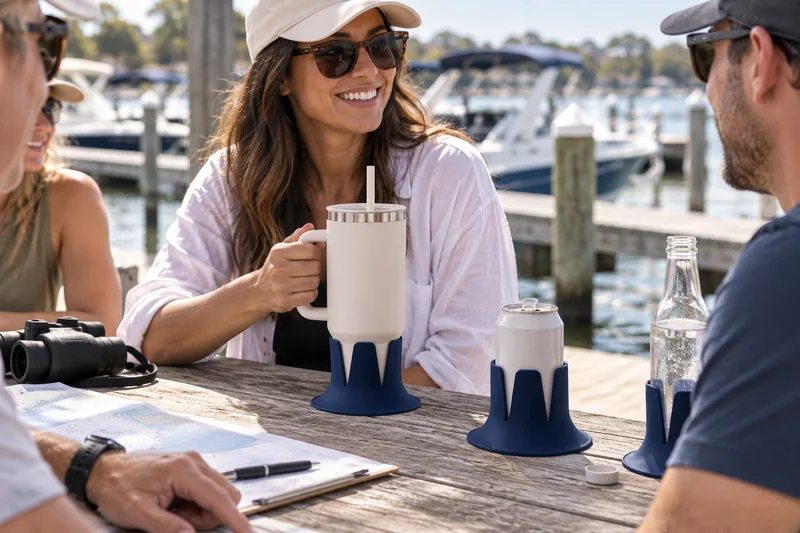
That constraint is the reason Steadi ends up in a lot of rental-day totes. It's a single piece of molded TPU — a fixed base 5.2 inches across and 2.8 inches tall, with flexible fins that grip the bottom inch of a can, bottle or tumbler. It attaches to nothing. There is no suction cup, no clamp, no adhesive, nothing to size to a rail you haven't seen.

The physics is the plain kind: your drink's own base is narrow, so it only takes a small tilt for its weight to swing out past the edge of that base. Setting the container into a fixed 5.2-inch base means the boat has to tilt a great deal further before that happens, and the tack of the TPU resists sliding on a slick cooler lid. It resists tipping. It doesn't do anything cleverer than that.

The honest limits matter more here than on your own boat:

What it does do is match the constraint exactly: nothing to install, nothing to leave a mark, nothing to explain at the walkthrough, and it goes home in the tote with the towels and turns up again at the pool, the tailgate and next summer's boat. It's dishwasher safe, it's molded in Orange, California, and it's patent pending. If it turns out not to be for you, there are 90 days from delivery to send it back, used is fine, returns free.

And one packing tip that costs nothing: phones go in the dry bag, not the cup holders. On most rentals the handful of molded holders is claimed by phones, keys and sunscreen before the boat clears the no-wake buoys. Take the phones out of that competition at the dock and you've roughly doubled the drink capacity of the boat before you've bought anything.


6. The tote, and the two bags inside it

One soft-sided bag, not three hard ones. It has to survive a dock, a gate, a cooler and being stepped on, then compress into a locker under a bench.

A dry bag or a zip pouch for phones, keys, wallets and the card. Everything in it is a thing that does not float, and the boat is a place where things get knocked off ledges by wakes you didn't cause.

Two trash bags. This is not tidiness, it's a line item. Cappy's requires all trash to be removed at return. (Cappy's Boats) Grant Motorsports adds "a $25.00 cleaning fee" if trash isn't removed. (Grant Motorsports) Long Beach Marina sets a minimum $100 cleaning fee for excessive trash or sand — and, worth knowing if anyone in the group smokes, a minimum $150 charge per burn mark. (Long Beach Marina) One bag for recycling, one for wet trash, both stashed somewhere they won't blow out at speed.

A microfiber towel and a small bottle of fresh water — your spill kit. Wiping a spill off vinyl in the first minute is a different job than scraping a dried ring off it at 4:50. This is the whole trick. Not special cleaner, not a product: a cloth someone can actually reach.

Beach towels for the seats you'll sit on longest. Sunscreened backs on white vinyl for eight hours is the same problem as the spray can, slower.

Water, in more quantity than feels reasonable. Sun, wind and a cooler full of seltzer dehydrate a crew faster than anyone plans for, and the person driving the boat should be the most hydrated and the least anything else aboard.


7. The five minutes at the dock that decide your deposit

You'll be handed a briefing you didn't ask for. Add five minutes of your own.

Photograph the boat before you leave. Boat-Ed's rental advice is direct: inspect the boat, and "if there are any problems, document them and take photos to avoid disputes." (Boat-Ed) Slow walk, video on, narrate: existing scuffs on the fencing, tears or stains in the vinyl, the fuel gauge, the deck. Thirty seconds of footage settles an argument that could otherwise cost you a four-figure hold. Grant Motorsports' agreement prices damage at "$100 per dent or cost of replacing a panel." Panels get dented at docks, by other people, on other days.

Ask three questions while somebody is still standing there. Where's the ladder release and does it lock down? Where does the anchor live and how do you set it? Which fuel rule is this — full at return, or billed after?

Do the drink triage. Count the molded holders, note where they are, put the phones in the dry bag instead. Decide where the cooler lives and don't move it — a cooler that stays put becomes a reliable surface; a cooler that migrates is a hazard.

Look at the fencing. Round or square, and roughly how thick. You can't act on it today. You'll know for next summer.


8. The 4:50 list

The return is the whole reason this list is shaped the way it is.

Reverse the tote: everything that came aboard goes in it. Then check the places things hide — under the bench cushions, in the storage lockers you opened once, behind the cooler, in the molded holders, on the deck under the table. Cans roll aft. They always end up at the stern.

Wipe the vinyl where anyone sat with sunscreen on, and any ring where a drink stood. Two minutes with the microfiber towel.

Then get in line. Late is expensive in a way that's out of proportion to the offence: Long Beach Marina charges a minimum of $100 per half hour, Cappy's charges $100 per half hour, and Grant Motorsports' agreement specifies double the normal rental rate for the overage plus the cost of coming to find you.


The list, condensed

Documents: boater card (printed), driver's license, credit card in the driver's name (not debit), screenshot of the agreement and the marina's number.

Confirm before you drive out: minimum renter age, whether fuel is included, whether an infant life jacket is provided.

Bring: one soft tote · one large cooler with block ice · water · a dry bag for phones and keys · two trash bags · a microfiber towel and a small bottle of fresh water · beach towels · mineral or non-spray sunscreen, applied in the parking lot · a non-DEET repellent · a compact Bluetooth speaker if the boat's stereo is unconfirmed · a drink base that attaches to nothing.

Leave in the car: glass, spray sunscreen containing avobenzone, DEET repellent, anything that has to clamp or suction to a boat you haven't measured, and the third cooler.

Do at the dock: photograph everything, ask the three questions, phones into the dry bag.

Do at 4:50: reverse the tote, check under the benches, wipe the vinyl, be on time.

None of that is boat gear. It's a bag you keep packed. The boat changes every summer; the bag doesn't.

Wondering about your specific cup? The fit database has sourced base measurements for 30+ containers — Stanley, Red Bull, Yeti, and the honest no's.

Sources

  1. Boat-Ed (Kalkomey) — Most people renting a motorized boat in the US are asked for a boater education card; CA, NY, NJ and HI require certification regardless of age; FL applies to operators born on or after Jan 1 1988 wit
  2. Long Beach Marina, Sebago Lake, Maine — Long Beach Marina (Sebago, ME) rental terms: 'No glass containers'; $1,500 deposit required on a major credit card, 'No debit cards'; minimum $100 cleaning fee for excessive trash or sand; minimum $15
  3. Bass Lake Boat Rentals (Bass Lake Marina, CA) — Bass Lake Boat Rentals: 'Time starts when you reserve the boat (time), regardless of arrival time, and arriving 15 minutes late after due time, you will be charged the full hour, at the hourly rate';
  4. Cappy's Boats — Cappy's Boats (Smith Lake, AL) rental terms: children's life jackets available on request except for children under 3, which guardians must provide; renters asked to arrive 30 minutes early and rental
  5. Grant Motorsports — Grant Motorsports pontoon rental agreement: '$25.00 cleaning fee' if trash is not removed; boat 'must be returned filled (to the top) with gas' or renter is 'charge for gas plus a $15.00 service fee';
  6. Salty Pontoons, Panama City Beach — A typical pontoon rental includes a map of the area, fuel, U.S. Coast Guard-approved life jackets for all passengers and all required safety equipment, plus a Bluetooth radio, a retractable Bimini top
  7. Barletta Pontoon Boats — Avobenzone, found in most sunscreens, 'can strip away the topcoat of the vinyl, exposing your seats to further wear and tear. Over time, this can cause the vinyl to crack and peel'; prevention is to a
  8. National Pesticide Information Center (Oregon State University / US EPA) — archived technical fact sheet, last reviewed July 2008 — 'DEET is a plasticizer and can damage certain rubber, plastic, vinyl, or elastic materials such as contact lenses, eyeglass frames and lenses, watch crystals, combs, painted and varnished surfaces, an
  9. ACE Boater — Federal law requires a capacity plate in sight of the helm on motorized monohull boats less than 20 feet (a class that excludes pontoons). The plate states the maximum persons capacity and, separately
  10. Boat-Ed (Kalkomey) — Renters should inspect the boat before renting and, 'if there are any problems, document them and take photos to avoid disputes'; read the rental agreement carefully regarding liability.
  11. National Pesticide Information Center (Oregon State University / US EPA), December 2009 — NPIC's picaridin fact sheet contains no warning that picaridin damages plastics, vinyl or synthetic materials — no counterpart to the plasticizer warning on the DEET fact sheet.
Choose your colors — free shipping

You'll finish at steadilabs.com — Steadi Labs is the manufacturer.